Left alone, a cannabis plant grows one dominant main cola with smaller side branches underneath fighting for light. Training reshapes that growth pattern so more of the plant gets equal light exposure — which usually means more total bud weight at harvest. The two most common beginner-friendly methods are topping and LST (low-stress training). They solve the same problem in different ways.
What Is Topping?
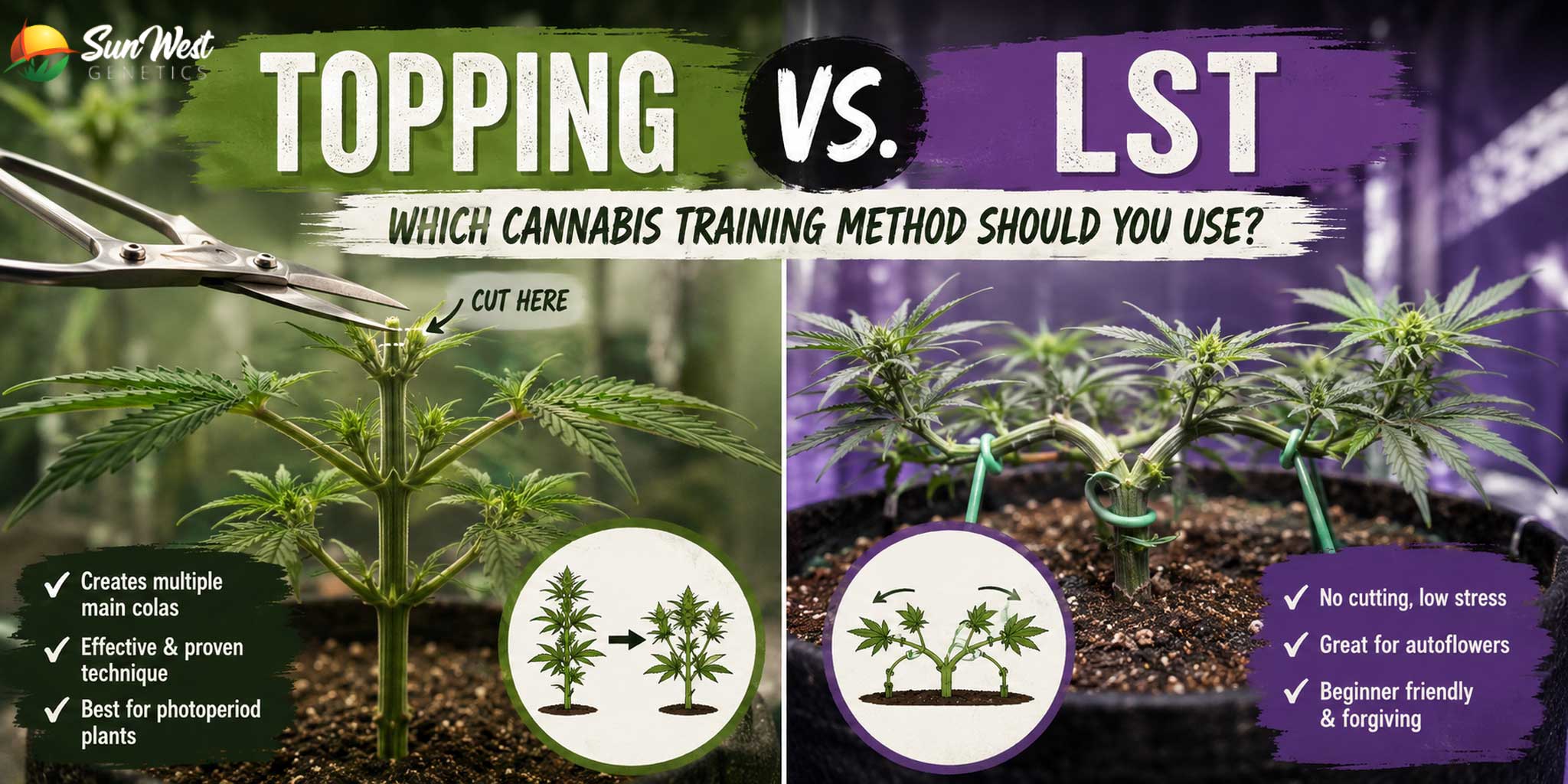
Topping means cutting off the main growth tip of the plant, usually above the third or fourth node. This removes the plant’s “apex dominance” — the hormonal signal that tells it to prioritize one main cola — and forces it to develop two (or more) new main colas from the nodes just below the cut.
Pros:
- Creates multiple even colas instead of one dominant one
- Effective, well-documented, works on almost any strain
- Can be repeated (topping the new colas again — called “FIMing” is a variant) for even more branching
Cons:
- It’s a real cut — the plant needs several days to recover, which can slightly delay overall growth
- Timing matters: top too early and you can stunt a young plant; top too late and you lose most of the benefit
- Not ideal for autoflowering strains with short vegetative windows — recovery time eats into their limited growth period
Best for: photoperiod (regular or feminized, non-auto) plants where you control the vegetative length, and growers comfortable making a clean cut.
What Is LST (Low-Stress Training)?
LST means gently bending and tying down branches — usually the main stem — so the plant grows sideways instead of straight up. No cutting involved. You’re using soft ties or plant yo-yos to hold branches in a wider, flatter shape, exposing more bud sites to direct light.
Pros:
- No cutting, so no recovery downtime or infection risk
- Works well on autoflowers, since there’s no growth-stalling stress
- Easy to undo or adjust as you go — very forgiving for beginners
Cons:
- Requires ongoing attention over several weeks (retying as the plant grows)
- Needs a bit more grow space width-wise since you’re training the plant to spread out
- Effects are more gradual than topping’s dramatic reshaping
Best for: autoflowering strains, beginners who want a lower-risk technique, and growers working with limited vertical space (grow tents, closets).
Side-by-Side Comparison
|
Topping |
LST |
| Technique |
Cutting the main tip |
Bending and tying branches |
| Recovery stress |
Moderate (several days) |
Minimal to none |
| Safe for autoflowers |
Use with caution |
Yes, generally safer |
| Skill level |
Beginner-intermediate |
Beginner |
| Space needed |
Vertical |
Horizontal |
| Can combine with other techniques |
Yes (often paired with LST) |
Yes (often paired with topping) |
Can You Combine Them?
Yes — and many experienced growers do. A common approach is to top a photoperiod plant once early in veg to establish multiple colas, then use LST throughout the rest of vegetative growth to spread those colas out evenly under the light. This combination is one of the more reliable ways to maximize yield in a limited-height grow tent.
Which Should a Beginner Choose?
If you’re growing an autoflower, default to LST — the short life cycle doesn’t leave much room for topping-recovery downtime, and LST’s gentler approach protects your yield potential.
If you’re growing a feminized photoperiod strain with a controllable vegetative stage, topping is worth learning — it’s simple, effective, and sets you up to add LST on top of it later in the grow.
Ready to put a training method to work? Autoflowering seeds are a great match for LST if you’re new to training, while our feminized seeds give you the longer vegetative window topping needs to pay off.

 ,
Canadian orders ship from Canada
,
Canadian orders ship from Canada
 .
.